



Reliable Information With and Without AI
At the beginning of an information search, the user finds themselves in an anomalous state of knowledge. This state, described by Belkin (1982), refers to the situation in which a person recognizes that their knowledge is incomplete, unclear, or contradictory for solving a particular problem. The gap between existing knowledge and needed knowledge causes discomfort.
Due to the retrieval paradox, the user cannot easily escape this state: in order to find the desired information quickly and precisely, the user would already need to know it and know which technical terms are relevant. It is precisely this knowledge that the searcher lacks at the outset. See section "2.2 The Retrieval Problem and its Consequences" in Peters, Braschler & Clough (2012).
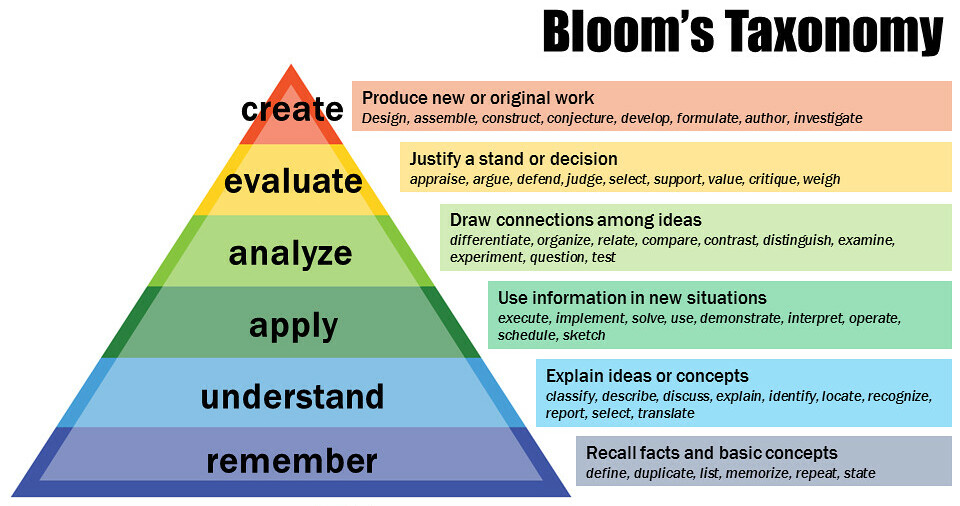
According to a new Harvard study by Deschenes & McMahon (2026), artificial intelligence is predominantly used today, whereas Google search used to be at the forefront (Griffiths & Brophy, 2005). Prompting for artificial intelligence proves to be demanding, as it requires higher language proficiency to give the AI precise instructions. In this respect, one operates at a higher level of Bloom's Taxonomy (1956) than with classic Googling, where one merely enters search terms.
Judging search results is also easier with Googling than assessing whether plausible-sounding AI answers are actually correct. Google search results can often be judged based on the source alone.
Whoever uses AI must climb even higher in order to verify the information found against authoritative information sources. To do this, the user must know the structure and the supported search strategies of the respective information sources. For example, AI-based legal information must be verified against statute and case-law databases, where future or superseded versions of legislation may also play a role — requiring legal expertise.
Conclusion: AI can lead to reliable results faster, but this is often considerably more demanding than searching without AI.
References
Belkin, N. J., Oddy, R. N., & Brooks, H. M. (1982). ASK for information retrieval: Part I. Background and theory. Journal of Documentation, 38(2), 61–71. https://doi.org/10.1108/eb026722
Peters, C., Braschler, M., & Clough, P. (2012). Multilingual information retrieval: From research to practice. Springer.
Deschenes, A., & McMahon, M. (2026, April 13). From search to strategy: What student AI use means for the future of academic libraries [Conference presentation]. Coalition for Networked Information (CNI) Spring 2026 Membership Meeting, Salt Lake City, UT, USA. https://www.cni.org/topics/information-access-retrieval/from-search-to-strategy-what-student-ai-use-means-for-the-future-of-academic-libraries
Griffiths, J. R., & Brophy, P. (2005). Student searching behavior and the web: Use of academic resources and Google. Library Trends, 53(4), 539–554.
Bloom, B. S., Engelhart, M. D., Furst, E. J., Hill, W. H., & Krathwohl, D. R. (1956). Taxonomy of educational objectives: The classification of educational goals. Handbook I: Cognitive domain. David McKay Company.
